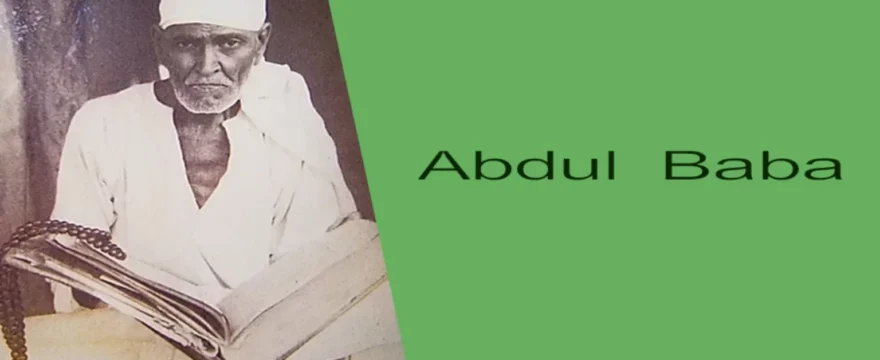
Abdul Baba, born around 1871 in Nanded, a city situated on the banks of the Tapti River, was a devout follower and close associate of Sai Baba of Shirdi. His father was conferred with the title of ‘Sultan’. Abdul Baba’s unwavering dedication and service to Sai Baba have cemented his place as one of the most revered devotees in the Sai Baba tradition.
Early Life and Spiritual Calling
Before his association with Sai Baba, Abdul Baba served a Sufi saint named Fakir Amiruddin in Nanded. According to accounts, Fakir Amiruddin had a dream in which Sai Baba appeared, handed him two mangoes, and instructed him to give them to Abdul Baba and send him to Shirdi. Upon waking, the Fakir found the mangoes beside him and, recognizing the significance of the vision, promptly sent Abdul Baba to Shirdi to meet Sai Baba.
Life in Shirdi and Service to Sai Baba
Abdul Baba arrived in Shirdi around 1889 or 1890, at approximately 18 years of age. Upon his arrival, he dedicated himself entirely to the service of Sai Baba, embodying the principles of Dasyam Bhakti (devotion through service) and Aatma Nivedanam (total surrender). His daily routine involved rigorous tasks such as cleaning, washing clothes, and maintaining the premises, all performed with minimal sleep and food, adhering strictly to Sai Baba’s instruction: “Eat very little and sleep very little.”
Role as a Caretaker and Disciple
Abdul Baba’s devotion extended beyond physical service; he was also the caretaker of Sai Baba’s mosque, the Dwarakamai. He was responsible for preserving and maintaining Sai Baba’s personal belongings and had the unique privilege of being in close proximity to the saint. This close association allowed Abdul Baba to imbibe Sai Baba’s teachings deeply and serve as a conduit for disseminating them to other devotees.
The Urdu Notebook
One of the significant contributions of Abdul Baba is the preservation of Sai Baba’s teachings through the Urdu notebook he maintained. This notebook contains records of Sai Baba’s words and interactions, providing valuable insights into his philosophy and practices. The notebook serves as a crucial document for researchers and devotees seeking to understand the depth of Sai Baba’s messages.
Life After Sai Baba’s Mahasamadhi
Following Sai Baba’s Mahasamadhi (passing) in 1918, Abdul Baba continued to live in Shirdi, dedicating his life to preserving the legacy of his guru. He played a pivotal role in guiding new devotees and maintaining the sanctity of the sites associated with Sai Baba. His unwavering commitment ensured that the spiritual practices and teachings of Sai Baba were upheld and transmitted to future generations.
Legacy and Passing
Abdul Baba’s life is a testament to selfless service and unwavering devotion. His contributions have left an indelible mark on the Sai Baba tradition, inspiring countless devotees to follow the path of humility and surrender. He passed away in April 1954, leaving behind a legacy of devotion that continues to resonate within the Sai Baba community.
Conclusion
The life of Abdul Baba exemplifies the profound bond between a guru and his disciple. His story is one of complete surrender, tireless service, and deep spiritual insight. Through his unwavering dedication, Abdul Baba not only served Sai Baba during his lifetime but also ensured that his teachings and legacy endured, illuminating the path for future seekers.